2026-05-29
Uber Plastic Surgery Rhinoplasty, Cartilage Special #3_Pros and Cons of Autologous Rib Cartilage, and When to Use It!
Uber Plastic Surgery Rhinoplasty, Cartilage Special #3_Pros and Cons of Autologous Rib Cartilage, and When to Use It! Hello. This is Uber Plastic Surgery! Part 3 of the rhinoplasty cartilage special with Dr. Seo Seung-jo! Today, we will tell you about autologous rib cartilage! First, shall we look at the types of cartilage used in rhinoplasty, which is one of the most frequently asked questions during a rhinoplasty consultation? The primary (

Uber Plastic Surgery Rhinoplasty, Cartilage Special #3_Pros and Cons of Autologous Rib Cartilage, and When to Use It!

Hello. This is Uber Plastic Surgery!
Together with Dr. Seo Seung-jo,
Part 3 of the rhinoplasty cartilage special!
Today, we will tell you
about autologous rib cartilage!

First, during a rhinoplasty consultation,
one of the most frequently asked questions is
about the types of cartilage used in rhinoplasty. Shall we take a look?
The primary (first choice) cartilages used are septal and ear cartilage.
If these are insufficient,
rib cartilage is used as a secondary (second choice) option.

These rib cartilages include autologous rib cartilage and donated rib cartilage.
Generally, we recommend donated rib cartilage first,
and recommend the use of autologous rib cartilage in special cases.
In conclusion, autologous rib cartilage is not commonly used
in primary rhinoplasty!

Then, why is autologous rib cartilage
not often used in primary surgeries?
Shall we look closer at its characteristics, pros, and cons?

Autologous rib cartilage has many advantages.
It provides an abundant amount, is long and sturdy,
and because it is your own cartilage, it is highly resistant to infection,
making it an excellent material for rhinoplasty.

If there are pros, there must be cons, right?
Harvesting autologous rib cartilage is more cumbersome compared to septal or ear cartilage.
Also, since rib cartilage protects our internal organs,
it is located very close to the internal organs (lungs).
Although rare, if a mistake occurs during harvesting,
it could affect the lungs, right?

Because of this process, the surgery is performed under general anesthesia,
and due to a characteristic called the warping phenomenon,
where the cartilage tends to bend,
manipulating the cartilage itself can be difficult, which is another disadvantage.


The decisive reason why autologous rib cartilage is not commonly used
is that there is a very convenient alternative!
That is donated rib cartilage.
Therefore, unless it is absolutely necessary,
we do not often use it!

Nevertheless, I will tell you about the cases
where autologous rib cartilage should be used even in a primary surgery.
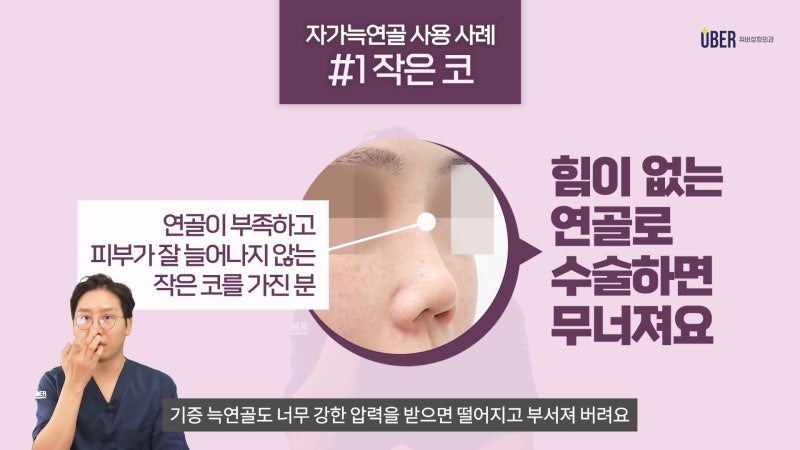
The first is a small nose.
As mentioned earlier, autologous rib cartilage
is a very sturdy and strong cartilage.
People with small noses not only lack cartilage,
but their skin also does not stretch well.
If operated on with weak cartilage (septal, ear, or donated rib cartilage),
the structure will collapse.
However, because autologous rib cartilage has great strength,
we can use this strength to create a supportive force.
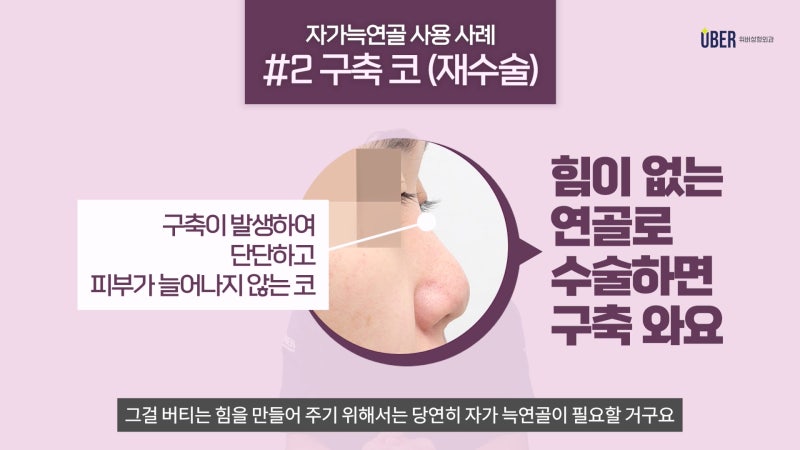
The second is a nose requiring revision rhinoplasty due to contracture.
A contracted nose, which is hard and inflexible,
has a very strong tendency to contract again
if revised with weak cartilage.
To create the strength to withstand this,
it is best to use autologous rib cartilage.

The third is a nose that severely lacks cartilage.
In cases where cartilage is extremely insufficient,
to prevent infections caused by foreign cartilage,
we recommend safe autologous rib cartilage.

The reasons autologous rib cartilage is more resistant to infection than donated rib cartilage are:
First, it is your own cartilage, and
second, donated rib cartilage, which belongs to someone else,
loses its strength during the process of removing cellular components to eliminate antigenicity,
so while it looks sturdy on the outside, it crumbles easily.
However, autologous rib cartilage does not undergo any separate processing,
so it remains very sturdy and does not crumble!

Today on 'Uber Informs,' we covered Part 3 of the rhinoplasty cartilage special,
explaining autologous rib cartilage!
Autologous rib cartilage is an excellent material,
and it must be used when necessary.
So don't be afraid thinking it's a difficult surgery,
and come get a consultation with Dr. Seo Seung-jo at Uber Plastic Surgery!

If you found today's topic on 'Uber Informs' helpful,
please make sure to subscribe and like our YouTube channel!
See you next time! Bye~