2026-05-29
UBER Plastic Surgery Rhinoplasty, Cartilage Special #2_Characteristics, Side Effects, and Causes of Artificial Cartilage (Mesh) Explained Clearly!
UBER Plastic Surgery Rhinoplasty, Cartilage Special #2_Characteristics, Side Effects, and Causes of Artificial Cartilage (Mesh) Explained Clearly! Hello. This is UBER Plastic Surgery! In our last "UBER Explains" segment, we discussed the pros and cons of donated rib cartilage and precautions during surgery! Today, as promised, we will continue by looking into artificial cartilage!
UBER Plastic Surgery Rhinoplasty, Cartilage Special #2_Characteristics, Side Effects, and Causes of Artificial Cartilage (Mesh) Explained Clearly!

Hello. This is UBER Plastic Surgery!
In our last "UBER Explains" segment,
we discussed the pros and cons of donated rib cartilage,
and the precautions to take during surgery!
In today's "UBER Explains," as promised,
we will continue by looking into artificial cartilage!

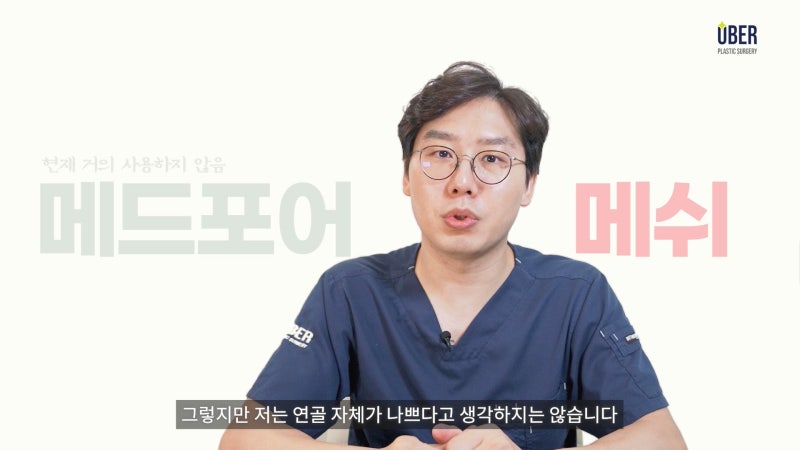
There are two types of artificial cartilage.
Medpor, which is rarely used nowadays, and
a cartilage called mesh.
This mesh, much like donated rib cartilage,
has generated a lot of controversy.
First of all, Dr. Seo Seung-jo of UBER Plastic Surgery
does not hold the view that artificial cartilage is bad.
Of course, opinions on this may vary!
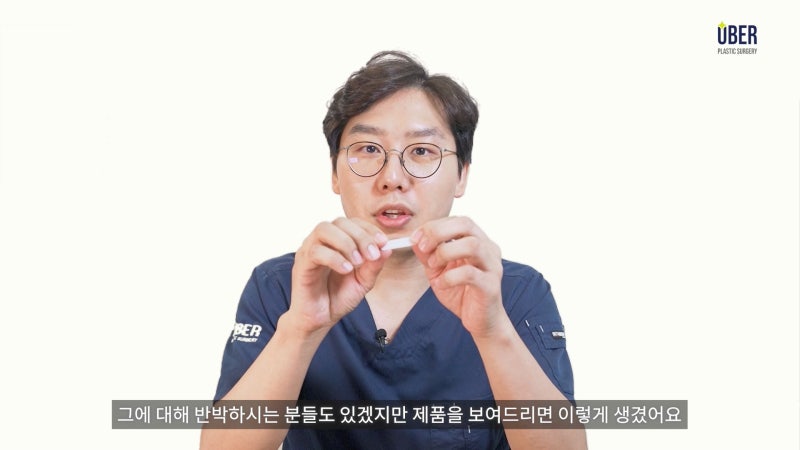
If you look at artificial cartilage (mesh), it is somewhat soft
yet possesses a certain degree of strength.
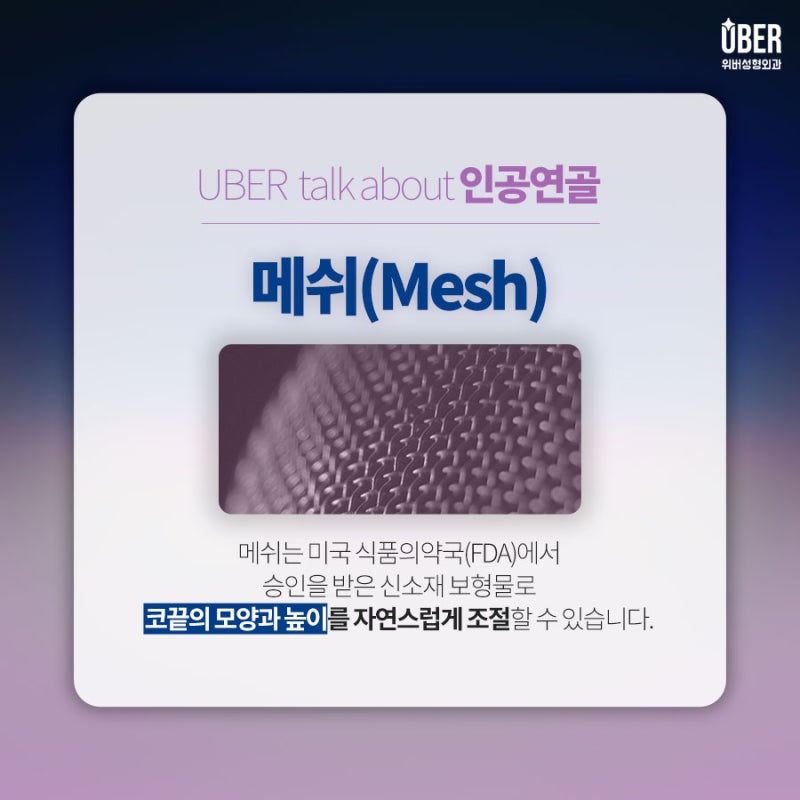
It is a cartilage made of a net-like structure called PCL,
which has microscopic pores.
It is through these pores that tissues
grow into and engraft.

The reason for using artificial cartilage is similarly
when one's own cartilage lacks sufficient strength,
it is used to restore and support that cartilage.
A major characteristic is that, unlike donated rib cartilage, after 2 to 3 years,
it dissolves and disappears.

Therefore, sometimes when performing revision surgery on someone
who had their primary surgery with artificial cartilage,
we find that the cartilage has dissolved significantly,
sometimes disappearing without a trace.

One of the reasons artificial cartilage was initially popular
was because it felt very soft to the touch.
So many people thought that even when the artificial cartilage dissolves,
the nose would remain soft.

However, artificial cartilage is not used on its own;
it is used as a supplement when one's own cartilage lacks strength,
and the surgery is calculated so that even if it dissolves later,
the structure will not collapse.

Among those who have had surgery with Dr. Seo Seung-jo at UBER Plastic Surgery,
there are no such cases,
but there are many cases of patients complaining about side effects from artificial cartilage.
Let's look into the reasons for this in detail.
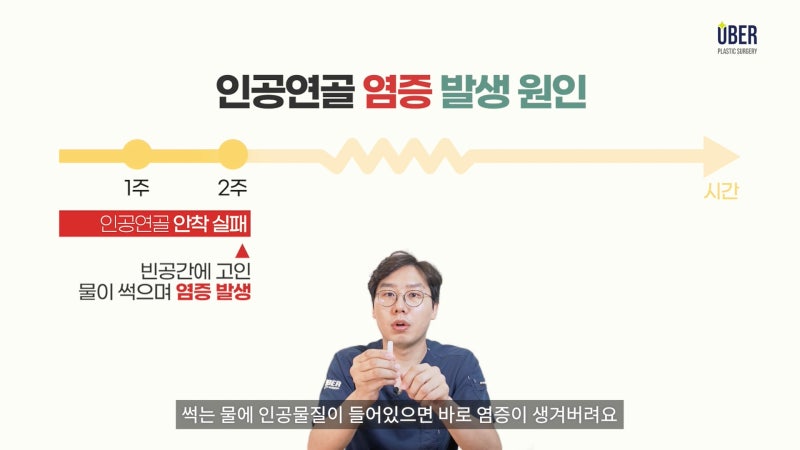
Within a short period after surgery (between 1 to 2 weeks),
tissues must settle into the microscopic pores
of the artificial cartilage. If they fail to do so,
fluid accumulating in the empty spaces can become infected,
leading to inflammation within 1 to 2 weeks.
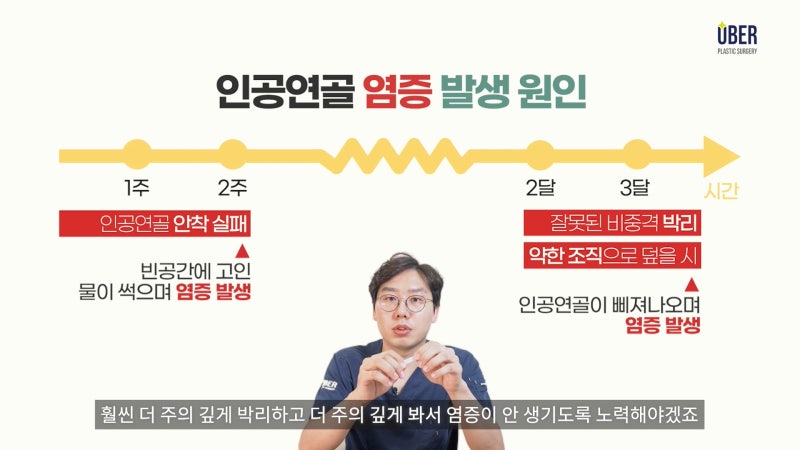
Also, there are patients who say that after 2 to 3 months, rather than 2 to 3 weeks,
the artificial cartilage has protruded.
In these cases, due to incorrect septal dissection,
too much artificial cartilage was used,
and it was covered with weak tissue lacking sufficient blood supply,
causing the tissue to fail to grow properly and eventually perforate.
Therefore, when using artificial cartilage, the dissection process
must be performed much more carefully
to prevent inflammation!

The reason artificial cartilage must be used despite these side effects is that
if you insist on using only autologous cartilage when it is insufficient,
revision surgery becomes inevitable. Please keep this in mind.
However, if you still want a surgery using only autologous cartilage,
carefully check the considerations for the surgery,
and even if it feels a bit lacking, please only elevate your nose
to the extent possible with your autologous cartilage!

Today, together with Dr. Seo Seung-jo of UBER Plastic Surgery,
following the "UBER Explains" donated rib cartilage episode,
we learned about artificial cartilage~
Regarding the use of donated rib cartilage and artificial cartilage,
you don't need to be too anxious or worried.
If you have any more questions about this,
please leave a comment, and we will answer them sincerely!

UBER Plastic Surgery YouTube and Blog
Don't forget to subscribe and like,
and we'll see you next time! Bye~
Frequently Asked Questions
Is artificial cartilage (mesh) used in nose surgery permanent?
No, it is not permanent. Unlike donated costal cartilage, artificial cartilage typically dissolves naturally within 2-3 years after being inserted into the body. Therefore, during surgery, it is used as a supplementary material, calculated so that the shape of the nose does not collapse even if the cartilage dissolves later.
What causes early inflammation after artificial cartilage (mesh) surgery?
It occurs when tissues do not settle properly within 1-2 weeks after surgery. Artificial cartilage has tiny holes, and tissues need to grow into these holes. If stagnant fluid in the empty spaces becomes contaminated, it can lead to early inflammation, so caution is required.
Can artificial cartilage protrude months after surgery?
Yes, it can happen if used excessively. If artificial cartilage is used excessively due to incorrect septal dissection and covered with weak tissue with insufficient blood supply, the tissue may not grow properly, leading to a side effect where the cartilage penetrates the skin and becomes exposed 2-3 months later.
Why is artificial cartilage used despite the risk of side effects?
It is used to restore the shape of the nose when autologous cartilage is insufficient or weak. If one insists on using only autologous cartilage when it is insufficient, the nasal tip may collapse, making revision surgery unavoidable. If you only want autologous cartilage, you must consider that there are limitations to how much the nose can be raised.