2026-05-29
Pros and Cons of Autologous Rib Cartilage Rhinoplasty
#AutologousRib #Rhinoplasty #AutologousRibCartilage #RevisionRhinoplasty #ProtrudingMouthNose #ShortNose #LongNose #GangnamRevisionRhinoplasty #GangnamRhinoplasty #GangnamLongNose #GangnamAutologousRibCartilage #Rhinoplasty #UberProtrudingMouthNose #Uber #UberRevisionRhinoplasty #SeoSeungJo #ShimJungHwan #ParkSunHeeHello, 💙your beauty universe! This is Uber Plastic Surgery :)💙 Along with eye surgery, it's one of the most representative surgeries that come to mind when you think of plastic su
#AutologousRib #Rhinoplasty #AutologousRibCartilage #RevisionRhinoplasty #ProtrudingMouthNose #ShortNose #LongNose #GangnamRevisionRhinoplasty #GangnamRhinoplasty #GangnamLongNose #GangnamAutologousRibCartilage #Rhinoplasty #UberProtrudingMouthNose #Uber #UberRevisionRhinoplasty #SeoSeungJo #ShimJungHwan #ParkSunHee
Hello,
💙your beauty universe! This is Uber Plastic Surgery :)💙
Along with eye surgery, it's one of the most representative surgeries that come to mind when you think of plastic surgery, right?
Rhinoplasty is a procedure that many of you contemplate and actually undergo a lot.
Today, I will explain the materials used in rhinoplasty,
and share my honest thoughts on the pros and cons of rhinoplasty using rib cartilage, a material that often comes with various issues.
What materials are used in rhinoplasty?


First of all, rhinoplasty is literally shaping the nose, but there is a structural aspect I need to explain first.
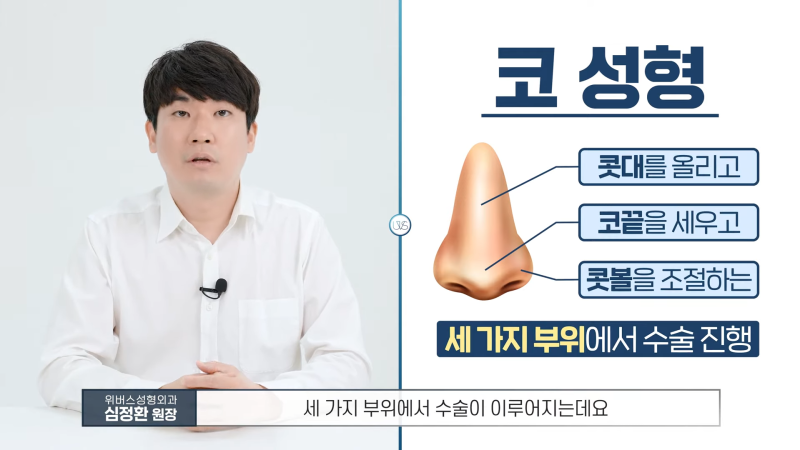
We broadly call it rhinoplasty, but it usually involves raising the nasal bridge, elevating the nasal tip, and adjusting the alar base,
meaning the surgery is performed on three different areas.
Among these, an implant is generally placed on the nasal bridge, while cartilage is used in areas like the nasal tip that require structural support from underneath.
The materials used in rhinoplasty are considered based on various variables and environmental factors.
First, it depends on the patient's nose shape, such as whether the nasal bridge is too low,
or if the bridge is already high enough but the drooping tip needs to be elevated,
whether the nasal skin is thick or thin, how elastic the skin is, and whether the septum is sufficient and thick enough.
Depending on these factors, various materials are chosen.
Generally, silicone implants or autologous rib cartilage are often used for the nasal bridge.
For the nasal tip, in the past, L-shaped silicone implants that covered everything down to the tip were used,
but due to issues where the silicone irritated and thinned the skin, eventually causing extrusion,
it has become much more common to use the patient's own cartilage for the tip, such as ear cartilage, septal cartilage, or rib cartilage.
This approach is now widely preferred.
Typically, septal and ear cartilage are used to shape the nasal tip.
If the patient has a small amount of septal cartilage or if a large amount of cartilage is needed,
or if it is a revision surgery and septal cartilage is insufficient, rib cartilage becomes necessary.
There is also donated rib cartilage, known as irradiated homologous costal cartilage (IHCC),
so depending on the situation and the patient's preference, either donated rib cartilage or autologous rib cartilage is used.
Occasionally, patients inquire about implant-free rhinoplasty.
Implant-free rhinoplasty refers to a procedure where, instead of artificial implants like silicone or Gore-Tex,
only materials from your own body are used. It would be good to keep this in mind.
When is autologous rib cartilage used?

As mentioned briefly earlier, due to anatomical structure or in the case of revision surgery,
there may be cases where it is difficult to use ear cartilage or septal cartilage.
Also, based on the patient's personal preference, if they desire a more glamorous and projected nose
than what can be achieved with those materials, the use of autologous rib cartilage can be considered.
Usually, ear cartilage or septal cartilage is a softer tissue compared to rib cartilage.
By carefully trimming, folding, and suturing these materials, we ensure they can withstand the various forces acting on the nose.
However, no matter how well the surgery is performed, there are bound to be some limitations.
Even if the nose is elevated with cartilage, the contracting force during the skin healing process
is stronger than expected, so some people slightly regret it when the swelling subsides and the result looks too natural.
Recently, a "naturally glamorous" (Jaryeohan) nose, which is neither too natural nor too flashy, has been gaining a lot of popularity.
In such cases, I can say that there are quite a few instances where rib cartilage must be used to achieve the desired height.
Pros and Cons of Autologous Rib Cartilage

Starting with the disadvantages of autologous rib cartilage, the first is that it leaves a scar.
It is not severely disfiguring or large, but a scar is inevitable.
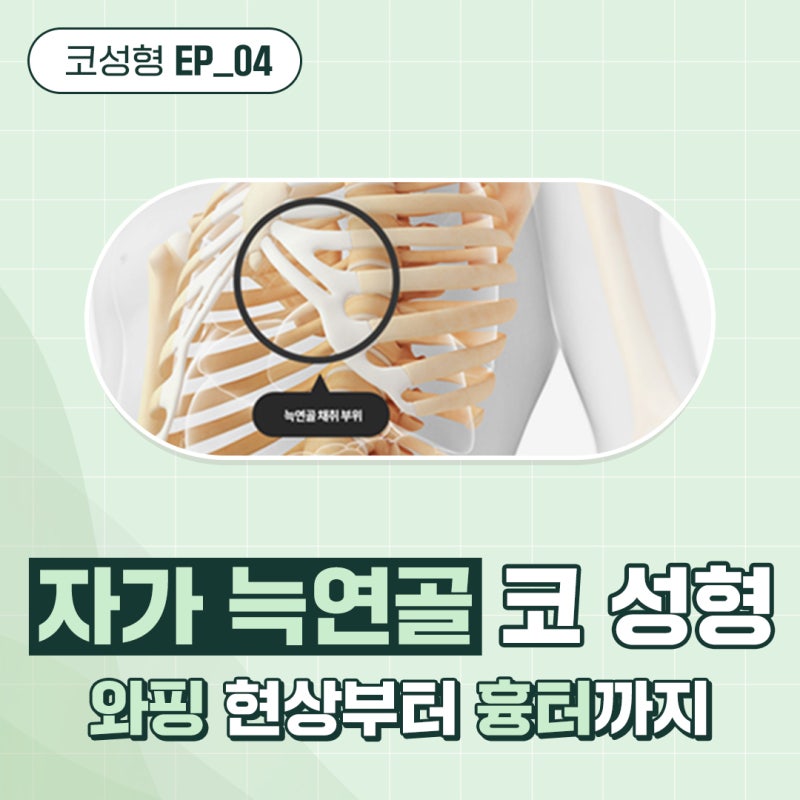
Rib cartilage, as the name suggests, refers to the cartilage attached to the ribs.
To harvest this cartilage, a small incision must be made in the rib area,
which leaves a scar of about 2.5 to 3 cm at the harvest site.
Of course, in our clinic, we provide care to minimize the scarring on the rib area as much as possible,
but it can still be a slight burden.
The second disadvantage is that the surgery time becomes longer.
Since it requires both the harvesting procedure and the main rhinoplasty surgery, the overall time is inevitably extended.
And the third is the warping of the nose, which many people worry about.
After harvesting the autologous rib cartilage, it is sliced thinly to be used in the nose.
During this process, about 3 to 5% of warping can occur.
This is called the warping phenomenon. It usually happens within 30 minutes after manipulation, so by cutting the rib cartilage in advance
and checking if warping occurs during the rhinoplasty procedure, we can take this into account
before applying it to the nose, thereby significantly reducing such unexpected deformations.
Fourth is the calcification of autologous rib cartilage.
Autologous rib cartilage tends to calcify, especially as we age.
Calcified cartilage becomes as hard as bone, making it impossible to manipulate and difficult to use as a material for rhinoplasty.
Usually, we check in advance by piercing the autologous rib cartilage area with a needle,
but sometimes we find it calcified only after opening the area.
In such cases, a situation may arise where we have no choice but to use donated rib cartilage.
Disadvantages
✅ Leaves a scar
✅ Longer surgery time
✅ Warping of the nose
✅ Calcification
Next are the advantages. As I mentioned a lot earlier, compared to other materials, it has superior strength and abundant quantity,
making it much more stable to achieve the desired height or correct a deviated nose.
Even in noses that are hard due to excessive scar tissue from multiple surgeries, or where the skin barely stretches due to contracture,
its ability to provide strong structural support is a major advantage.
Also, the inflammatory response after surgery is relatively low,
and even if inflammation does occur, it can be controlled with prescribed medication, which is another advantage.
Advantages
✅ Superior strength and abundant quantity compared to other materials, allowing for the desired height
✅ Stable correction of a deviated nose
✅ Strong enough to support a contracted nose or a nose with tight skin
✅ Low inflammatory response
So far, we have briefly looked at the overall types of materials used in rhinoplasty,
and specifically examined the pros and cons of rib cartilage.
From the perspective of a rhinoplasty surgeon, it would actually be very convenient if the materials were unified and the surgical methods were identical.
However, every patient's desires are different, and each patient's nose shape, skin, and available cartilage materials vary,
so that is simply not possible, right?
In making your precious face more beautiful and attractive, considering various conditions and situations,
constantly contemplating what the best material would be and how best to perform the surgery,
and communicating with the patient is an essential quality that a plastic surgeon must possess.
In this sense, I never say that rib cartilage is unconditionally the best material,
or that using only this will guarantee the exact results you want.
For some patients, if it is judged that surgery with rib cartilage
is the best choice compared to other materials, there is no reason to hesitate.
Of course, if the patient strongly opposes it, I do not force it.
Because I must do my best to create the shape the patient desires without using rib cartilage.
However, in such cases, I first explain that there might be a slight difference between what is desired and what is possible,
and after also explaining the potential situations that could arise if rib cartilage is used,
I propose the most suitable option. Since the final choice is up to the patient, if you think deeply and carefully from various angles
about the clinic, the surgeon, and the surgical materials before proceeding with the surgery,
I believe it will lead to less regret and, conversely, highly satisfactory surgical results.
Thank you for watching this long video,
and I will see you next time with an even more informative video.
Thank you.
https://www.youtube.com/watch?v=XSSrj1ZkQg0
❤ If you want a quick consultation?



Frequently Asked Questions
When is autologous costal cartilage rhinoplasty necessary?
It is primarily needed when there is insufficient septal cartilage or ear cartilage. Especially when undergoing revision rhinoplasty or desiring a glamorous and prominent nose shape that is difficult to achieve with existing cartilage, the use of autologous costal cartilage is considered.
Does autologous costal cartilage harvesting leave a large scar?
No, a relatively small scar of about 2.5-3cm remains. Since cartilage is harvested by making a small incision in the rib area, a scar is inevitable, but it can be minimized through the hospital's management.
Can the nose become crooked if autologous costal cartilage is used?
Yes, there is a probability of about 3-5% for warping to occur. However, it usually happens within 30 minutes after manipulation, so if the cartilage is cut in advance during surgery and checked for warping before use, deformation can be significantly reduced.
What is the biggest advantage of autologous costal cartilage rhinoplasty?
The biggest advantage is that it has higher strength and is more abundant than other cartilages. Thanks to this, it is good for raising the nose to the desired height or correcting a crooked nose, and it can firmly support noses with a lot of scar tissue or contracture. Inflammatory reactions are also less common.
Can autologous costal cartilage not be used as one gets older?
Yes, this is because as age increases, calcification can progress, making the cartilage harden like bone. If calcification is severe, manipulation is impossible, making it difficult to use as a material for rhinoplasty, and in this case, it may need to be replaced with donated costal cartilage.