2026-07-16
What exactly is a semi-straight nose line? Differences from straight and semi-upturned noses
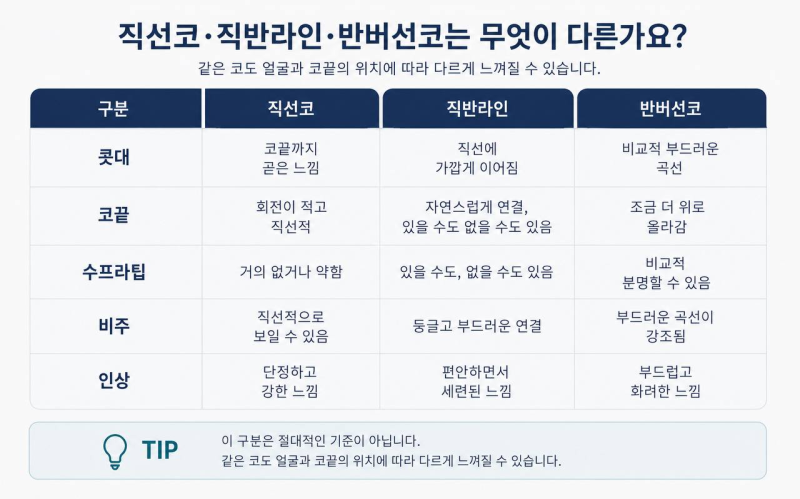
The semi-straight nose line is not a formal medical term. It generally refers to a nose shape in women where the bridge is relatively straight, and the tip is softer than a straight nose but less upturned than a semi-upturned nose.
#semi_straight_nose_line #female_semi_straight_line #semi_upturned_straight_nose #semi_straight_nose #straight_nose #semi_upturned_nose #supratip_break #nasofacial_angle #nasolabial_angle

What exactly is a semi-straight nose line?
Let me start with the conclusion:
‘Semi-straight line’ is not a formal medical term.
Generally, in women's noses, it refers to a shape where the nasal bridge descends relatively straight,
and the nasal tip is softer than a straight nose but less upturned than a semi-upturned nose.
This is often called a ‘semi-straight line’ or ‘semi-upturned straight line’.
However, a semi-straight line cannot be distinguished solely by a subtle curve on the nasal dorsum.
I place more importance on whether the inclination of the nasal bridge, the position of the nasal tip, the nasolabial angle, and the shape of the rounded columella
collectively create a feminine harmony.
Is the semi-straight line a medically defined nose shape?
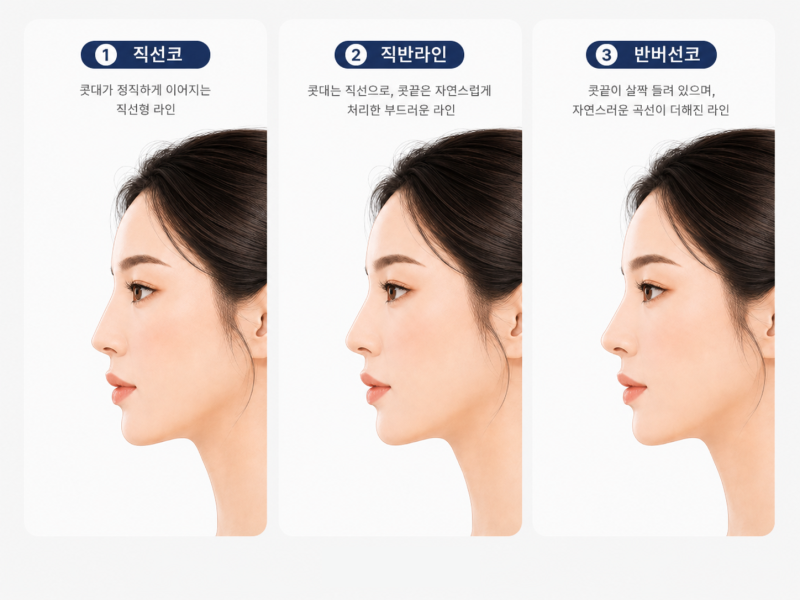
Expressions like ‘semi-straight line’, ‘semi-upturned straight line’, and ‘semi-straight nose’
are primarily used by patients to describe their desired nose image.
On the internet, the following types of noses are generally described as semi-straight lines:
▪️A nose where the bridge descends relatively straight
▪️A nose that becomes very subtly higher towards the tip
▪️A nose with less curvature just before the tip than a semi-upturned nose
▪️A nose with a smoother connection between the tip and columella than a straight nose
However, in actual consultations, many patients show slightly different nose photos
and all refer to them as ‘semi-straight lines’.
Therefore, rather than memorizing one fixed shape,
it is more important to understand what aspects the patient perceives as a semi-straight line.
Is a supratip break necessary for a semi-straight line?
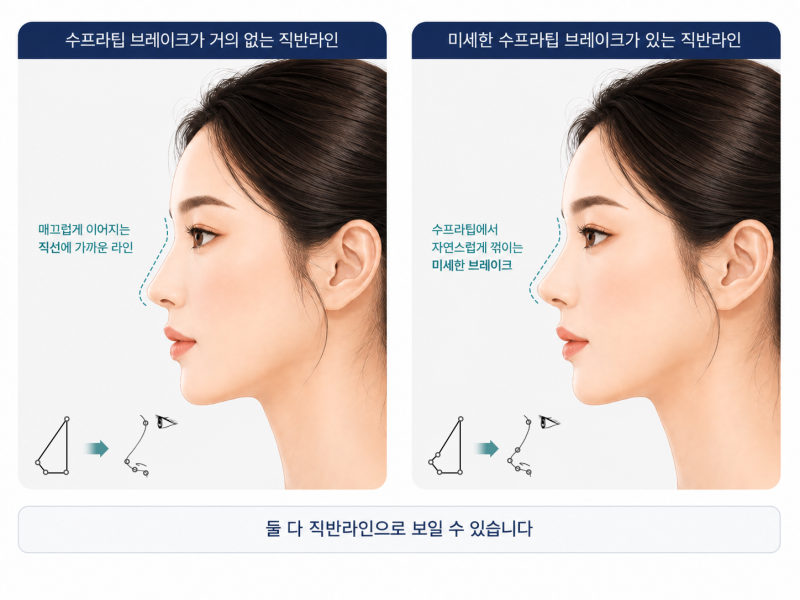
A supratip break refers to a shape where the area just above the nasal tip is subtly indented,
making the nasal tip appear slightly more prominent.
While this feature can gently emphasize the nasal tip,
it is not absolutely necessary for a semi-straight line.
Even if the nasal bridge extends relatively straight to the tip,
if the following conditions are met, it can be perceived as a feminine semi-straight line:
▪️The angle formed by the face and the nasal bridge
▪️The projection and rotation of the nasal tip
▪️The angle formed by the columella and the upper lip
▪️The rounded and soft shape of the columella
In other words, it is difficult to distinguish between a straight nose and a semi-straight line based solely on the curve of the nasal dorsum.
Three criteria for a feminine semi-straight line, according to Dr. Seo Seung-jo
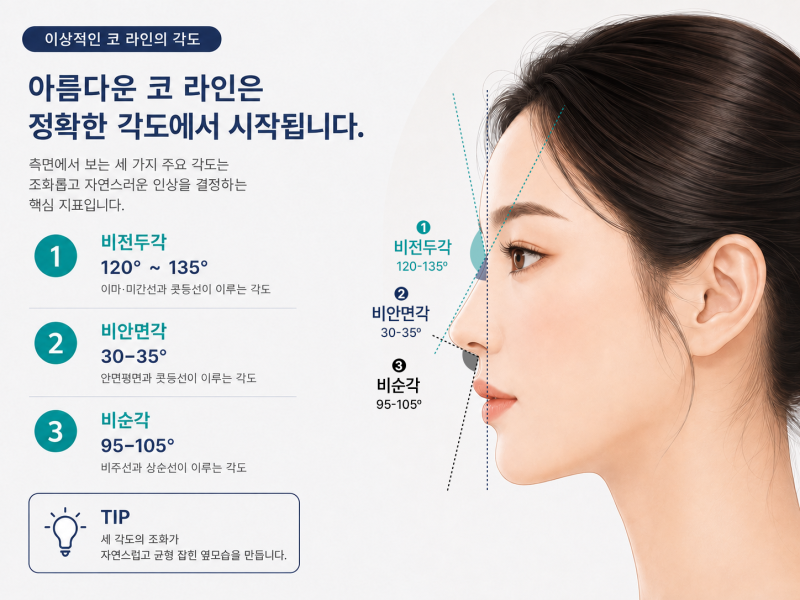
1. Nasofacial angle formed by the face and nasal bridge
The angle formed by the facial plane and the nasal dorsum line in profile is called the nasofacial angle.
When designing a feminine semi-straight line,
I consider a nasofacial angle of approximately 30-35 degrees as a clinical standard.
This angle determines the inclination of the nasal bridge.
If the nasofacial angle is excessively small, the nasal bridge may appear low and gently sloped.
Conversely, to create a larger angle,
if the nasal tip is excessively projected forward or rotated upward,
the nose may appear to protrude or be upturned.
However, the 30-35 degree range is not an absolute standard applied identically to all patients.
It must be adjusted while considering the length and three-dimensionality of the face, as well as the position of the forehead, lips, and chin.
2. Nasolabial angle formed by the columella and upper lip
The angle formed by the columella line and the upper lip line is called the nasolabial angle.
For a feminine semi-straight line, a range of approximately 95-105 degrees is generally considered a standard,
but this can vary depending on the length of the nose, lip protrusion, and nasal tip position.
If the nasolabial angle is excessively large, the nasal tip may appear upturned, and nostril exposure may increase.
Conversely, if it is too small, the nasal tip may appear droopy or give the impression of a long nose.
3. Soft and rounded columella
The columella is the column between the nostrils.
While the columella itself does not determine the nasal bridge line,
if the columella is excessively flat, angular, or recessed inward compared to the alar,
many patients do not perceive this as a feminine semi-straight line.
When viewed from the side, the columella should connect to the upper lip with a soft curve,
and its relationship with the alar should also be natural to achieve the characteristic soft impression of a semi-straight line.
What is the difference between a straight nose, semi-straight line, and semi-upturned nose?
Common misunderstandings among patients
‘A semi-straight line can be achieved by just slightly raising the nasal tip.’
Simply raising the nasal tip does not create a semi-straight line.
It must be connected as a single flow from the nasion to the nasal bridge, nasal tip, columella, and upper lip.
‘If there is no supratip break, it's a straight nose.’
Not necessarily.
Even without a supratip break, if the inclination of the nasal bridge, nasolabial angle, and columella shape
harmonize in a feminine way, it can appear as a semi-straight line.
‘A semi-straight line is one fixed shape.’
A semi-straight line is not a single, fixed shape.
For each patient, the nasal bridge height, nasion, nasal tip projection and rotation, and nose length must be adjusted differently.
Frequently Asked Questions
Q. Are ‘semi-straight line’ and ‘semi-upturned straight line’ the same thing?
In patient consultations, they are often used with similar meanings.
However, the degree of curvature of the nasal tip that each clinic or patient envisions may differ.
Q. Is a semi-straight line a natural or glamorous nose?
It depends on how much the height and projection are adjusted.
It can be made relatively natural,
or it can be made into a ‘natural yet glamorous’ form.
Q. Is a semi-straight line only suitable for women?
This article explained it based on women's noses.
Men's noses require different criteria for judging the nasolabial angle, nasal tip rotation, and columella shape, so separate standards are needed.
Key takeaways
‘Semi-straight line’ is not a formal medical term.
It is not judged as a semi-straight line solely because the nasal bridge is straight;
the nasofacial angle, nasolabial angle, nasal tip position, and rounded columella shape must be considered together.
A supratip break may or may not be present.
In the next article, I will explain whether a semi-straight line is only suitable for certain face shapes.
✨Curious about Dr. Seo Seung-jo's more detailed rhinoplasty lectures?✨