2026-05-29
Under-Eye Fat Repositioning Explained by Dr. Shim Jung-hwan!
#UnderEyeFatRepositioning #UnderEyeFat #UnderEyeSurgery #GangnamEyeSurgery #GangnamPlasticSurgery #GangnamUnderEyeSurgery #GangnamStationPlasticSurgery #UpperBlepharoplasty #LowerBlepharoplastyHello~ your beauty universe! This is Uber Plastic Surgery :)Today, Dr. Shim Jung-hwan will be explaining under-eye fat repositioning.Shall we learn about under-eye fat repositioning?First, looking at the anatomical structure, the eyeball is enclosed within a bone called the orbit
#UnderEyeFatRepositioning #UnderEyeFat #UnderEyeSurgery #GangnamEyeSurgery #GangnamPlasticSurgery #GangnamUnderEyeSurgery #GangnamStationPlasticSurgery #UpperBlepharoplasty #LowerBlepharoplasty
Hello~
your beauty universe! This is Uber Plastic Surgery :)
Today, regarding under-eye fat repositioning,
Dr. Shim Jung-hwan will be explaining it to us.
Shall we learn about under-eye fat repositioning?
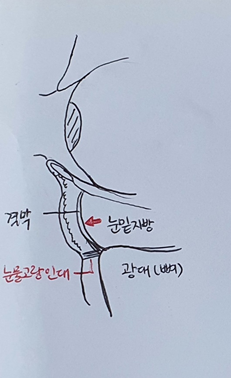
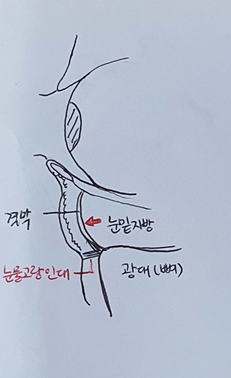
First, looking at the anatomical structure, the eyeball is surrounded by a bone called the orbit.
And the space between the bone and the eyeball is filled with fat.
The fat in the lower part is called under-eye fat, and the lower orbit is connected to the front cheekbone.
The under-eye fat is surrounded by a membrane called the orbital septum.
The under-eye fat enclosed by this septum supports and protects the eyeball.
However, due to gravity, the eyeball continuously presses down on the fat,
so as time passes, the septum weakens and the fat bulges forward.
At the bottom, it is firmly attached to the bone by the tear trough ligament, causing it to only bulge forward.
As the under-eye fat bulges forward and the area below it remains firmly fixed,
that area becomes relatively sunken, creating a shadow and appearing as what we commonly call dark circles.
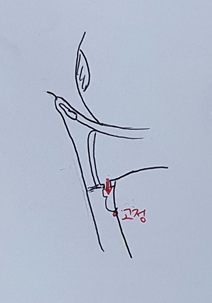
To resolve this, it is necessary to release the tear trough ligament, reposition and insert the under-eye fat into the space, and prevent re-adhesion.
During this process, for those with excess fat, some fat may be removed, while for those lacking fat, additional fat may be grafted.
When the surgery is performed this way, the bumpy, shadowed under-eye area becomes flat, and the tear trough ligament that fundamentally caused the issue is released, resulting in the disappearance of dark circles.
However, dark circles caused by dark under-eye skin pigmentation cannot be resolved with this surgery alone, so treatment using a pigment laser may also be necessary.
Under-Eye Fat Repositioning and Lower Blepharoplasty
Under-eye fat repositioning is a surgery typically performed on relatively young patients with good skin elasticity and no sagging.
It involves making an incision through the conjunctiva and performing the surgical process from the inside.
It has the advantage of leaving no visible external scars.
However, for those with sagging skin, simply treating the fat will not resolve the external skin issue, so the skin sagging must be addressed.
If under-eye fat repositioning is performed alone when there is skin sagging, the outer skin may look even more stretched, like a deflated balloon,
or fine lines may become more severe.
Therefore, in such cases, the surgery is performed by making an incision in the skin just below the eyelashes,
and the process of excising and pulling the excess skin must be combined, which is called lower blepharoplasty.
To put it simply, treating only the fat from the inside is under-eye fat repositioning.
When the outer skin needs to be excised together, you can think of it as lower blepharoplasty.
ex) Which procedure should I get for sunken under-eyes?
The choice between under-eye fat repositioning and lower blepharoplasty is determined based on the skin condition,
and in cases where the eyes are sunken due to a lack of fat, additional fat grafting may be required.
ex) What is the difference between under-eye fat repositioning and lower blepharoplasty?
Both procedures involve releasing the tear trough ligament and, if there is excess fat, removing a portion and repositioning the remaining fat.
The difference between the two surgeries lies in determining whether only the fat is the issue or if it is accompanied by skin sagging, and proceeding with the appropriate surgical method.
Under-eye fat repositioning is performed when under-eye fat is the issue and there is no skin sagging,
by approaching through the conjunctiva, leaving no external scars and conducting the surgery on the inside.
On the other hand, lower blepharoplasty is performed when skin sagging is present,
by approaching through the skin just below the lower eyelashes, excising the excess skin, and pulling it up.
ex) Can dark circles be improved with under-eye fat repositioning?
Dark circles can be divided into two types. The first is when shadows form in this area due to the tear trough ligament, appearing as dark circles,
and the second is when pigmentation occurs in the under-eye skin itself.
Among these, dark circles caused by the tear trough ligament can be eliminated through under-eye fat repositioning or lower blepharoplasty.
Dark circles caused by pigmentation can be improved through pigment laser treatments.
ex) If I get under-eye fat repositioning, can I not get lower blepharoplasty later?
No. After under-eye fat repositioning, as time passes, the fat may sag again and the skin will sag.
At that time, lower blepharoplasty can be performed to reorganize the fat and excise the excess skin.
How did you like the content we prepared today?
We will be back next time with even more informative content! ❤
https://www.youtube.com/watch?v=csnbDnCxj-U
❤ Want a quick consultation?


❤ Want to become prettier at Uber?