2026-05-29
Short Nose Rhinoplasty Explained by Dr. Seo Seung-jo of Uber Plastic Surgery! Types, Surgical Methods, and Characteristics of Autologous and Artificial Cartilage!
Short Nose Rhinoplasty Explained by Dr. Seo Seung-jo of Uber Plastic Surgery! Types, Surgical Methods, and Characteristics of Autologous and Artificial Cartilage!Hello! This is Uber Plastic Surgery. Among those considering rhinoplasty, there are many different types of noses.In today's 'Uber Explains,' we will find out with Dr. Seo Seung-jo how far short nose rhinoplasty can go using autologous cartilage!Before getting into the main to

Short Nose Rhinoplasty Explained by Dr. Seo Seung-jo of Uber Plastic Surgery! Types, Surgical Methods, and Characteristics of Autologous and Artificial Cartilage!
Hello! This is Uber Plastic Surgery.
Among those considering rhinoplasty,
there are many different types of noses.
In today's "Uber Explains,"
together with Dr. Seo Seung-jo,
we will find out how far short nose rhinoplasty
can be achieved using autologous cartilage!


Before we dive into the main topic,
what kind of nose do you consider to be a short nose?
The short nose that most people think of
is a "nose where the nostrils are visible,"
and many people think that in this case,
it must unconditionally be lengthened.
However, that is not actually the case!
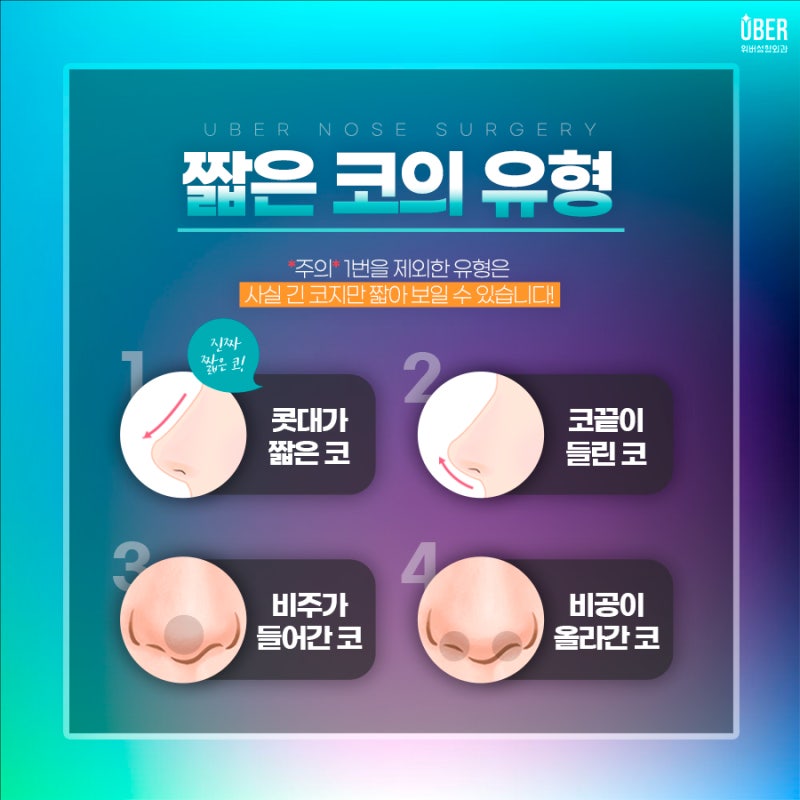
Then, let's accurately look into the types of short noses!

The first type is a nose with a short nasal bridge.
Rather than a nose with visible nostrils, this case
can be considered a truly short nose.

The second to fourth types
are cases that may or may not be truly short noses.
This is because even if it is not actually a short nose,
there are noses that appear short!

The second type is a nose with a long nasal bridge but an upturned nasal tip.
When the angle between the columella and the lips, meaning the nasolabial angle, is large,
it can give the impression that the nose is short,
but the actual length of the nasal bridge can be long.
In this case, lengthening the nose will make it too long,
but not lowering it is also not an option, making it a somewhat ambiguous case
that requires a lot of careful attention during surgery.

The third type is a nose with a retracted columella and drooping alars.
This is a case where it looks like a piggy nose.
A piggy nose is characterized by being short, upturned, and having a retracted columella,
but some people may have these features separately rather than all three at once.
The common characteristic is that even if they appear separately, they give the impression of a short nose.


Finally, the fourth type is a dragon nose.
The nostrils are elevated and visible,
but it is actually ambiguous to call it a short nose.
Because the nostrils are very visible even though the columella is lowered,
performing a short nose lengthening surgery on this can potentially result in an arrow nose.

Now that we know about the types of short noses,
it is also important to know
what kind of surgery should be done for each symptom, right?
Whether it is a short nose, an upturned nose, or a nose with a retracted columella,
in any of these cases, lengthening must be done regardless.

However, cases like the dragon nose where the nostrils are elevated
are a slightly different case that does not require lengthening,
so we will exclude it and move on!

For the other three cases, before proceeding with short nose rhinoplasty,
there are a few things that need to be checked!
How much the nose will be elevated,
how much cartilage the patient has,
and the condition of the skin are all very important factors.
Also, you must definitely consider whether it can overcome
the pressing tension even with a weak force.

Let's dive into the methods of short nose rhinoplasty!
Looking at our nose, there is a mucosal part on the inside
and a skin part on the outside.
The mucosa is attached to the cartilage. After separating these two,
both sides of the alar cartilage are stretched.

At this time, if the skin is tight, the cartilage will not stretch well,
which is why the skin condition is checked before short nose rhinoplasty.
Next, using autologous cartilage,
the inner mucosa and cartilage tissue are stretched out,
and the skin is draped over it. This is short nose rhinoplasty.
Therefore, how well the pushing force can withstand
the opposing covering force
determines the success of the surgery!

Then, is it possible to perform this short nose rhinoplasty
using only autologous cartilage without artificial cartilage?
Even if the septal cartilage is insufficient,
if the ear cartilage is sufficiently strong
and the skin is in a condition where it can stretch a bit, the surgery is possible.
However, if the nose is small and the skin is tight,
Dr. Seo Seung-jo of Uber Plastic Surgery generally does not recommend
or even discourages surgery using only autologous cartilage.

This is because some people think that using autologous cartilage has no side effects,
while using donated rib cartilage or artificial cartilage
does have side effects,
but even with autologous cartilage, contracture can occur if the surgery is done incorrectly.
Therefore, rather than unconditionally insisting on autologous cartilage,
it is more important to perform the surgery well with the materials that suit you!
Also, please keep in mind that there are many cases where autologous cartilage is sufficient!

If you make a surgical decision after sufficiently analyzing
the three cases mentioned,
you will achieve good surgical results!

Today, together with Dr. Seo Seung-jo of Uber Plastic Surgery,
we explained the types of short noses, short nose rhinoplasty methods,
and whether short nose rhinoplasty can be done with autologous cartilage!
What you consider a short nose and an actual short nose,
as well as how far it can be lengthened, may vary slightly.
If you are curious about a more definitive diagnosis, we recommend visiting Uber Plastic Surgery
and receiving a consultation from Dr. Seo Seung-jo!

Don't forget to subscribe and like
the Uber Plastic Surgery YouTube channel,
and we'll see you next time! Bye~