2026-05-29
3-Month Candid Review with the Director🩷(Nose Re-revision Surgery)
A patient who underwent a third nose surgery due to an unnaturally high nose and dissatisfaction with its shape shares their 3-month post-op experience. The focus was on creating a natural look, especially when smiling, using autologous costal cartilage for stable support.
#NoseRevision #NoseReRevision #RevisionSurgerySpecialist #NoseRevisionSpecialistHospital #DroopingNoseTip #NoseTipDroop #AutologousCostalCartilage #NasalBridge #NoseTipSurgery #NoseSurgerySideEffects #PlasticSurgerySideEffects #GangnamNoseRevisionHospital #BestNoseSurgeryClinic #GangnamPlasticSurgery #GangnamStationPlasticSurgery #SeoSeungJo #WeversPlasticSurgery
Hello~
💎Your beauty universe! This is Wevers Plastic Surgery :)💎
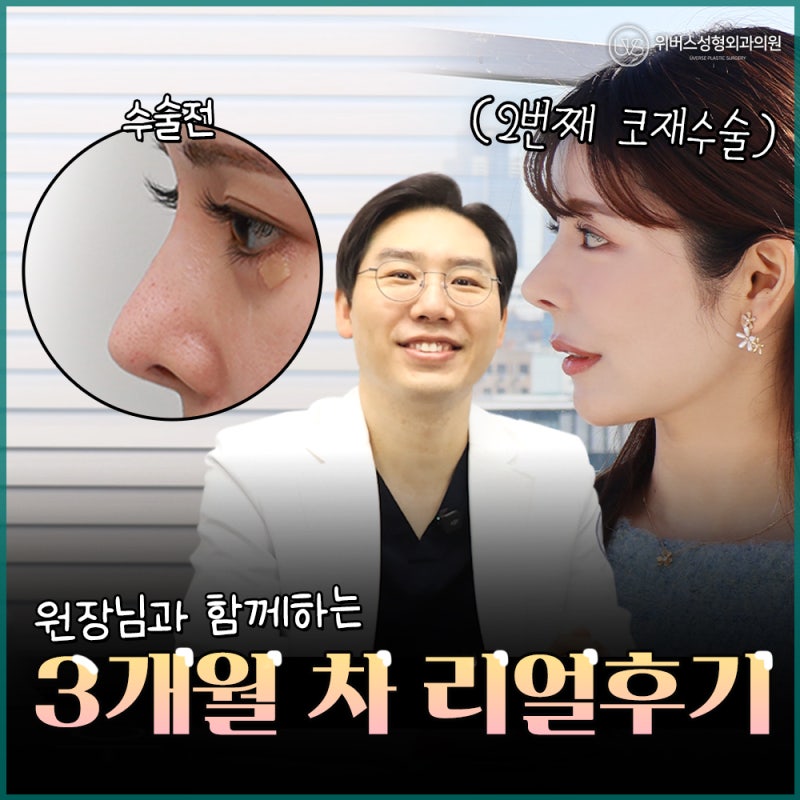
3 Nose Surgeries

This patient decided on a third nose surgery because their nose was too high after a previous revision surgery, making it unnaturally prominent and uncomfortable in daily life, and due to comments from others about its awkward shape.
It has now been 3 months since the nose re-revision surgery.
Immediately after the surgery, there was a slight concern that the nose tip might appear a bit upturned because it hadn't lowered sufficiently.
However, it's important to consider facial expressions and muscle movements when smiling,
so the nose re-revision surgery was performed with the aim of not overly lowering the nose tip from the start.
Since the patient had a muscle type where the nose tip lifts significantly when smiling,
excessively lowering the nose could have made it look unnatural, potentially resembling a ‘Squidward nose’.
Considering these points, the surgery was performed, and fortunately, the patient was satisfied with the result.
Both Korean and Japanese patients often express concerns about implants,
frequently asking, ‘Don't they need to be replaced every 10 years?’
However, in nose surgery, the area where problems typically arise first is usually the nose tip, not the nasal bridge.
The key to nose tip surgery is not simply raising or lowering it,
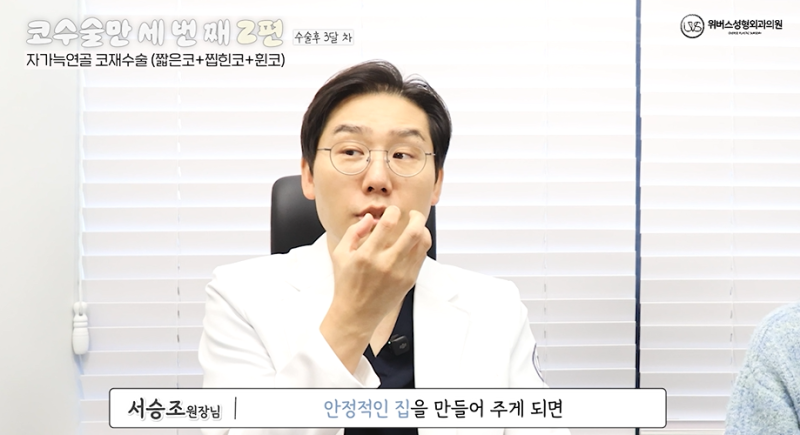
but creating a ‘comfortable structure’ where the silicone can settle stably.
This is also why autologous cartilage (autologous costal cartilage) is often used in nose surgery.
By creating a stable support structure for the nose tip with autologous tissue,
the silicone can remain stable and comfortable even when smiling or making expressions.

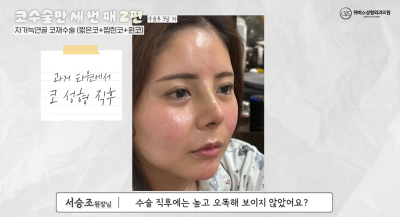
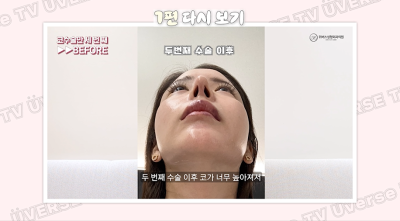
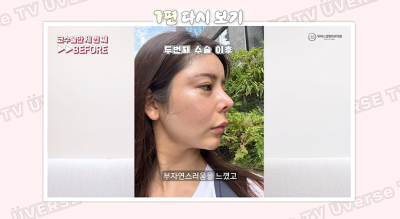
These are photos of the patient taken immediately after a previous nose surgery at another clinic.
Her nose tip wasn't significantly drooping initially,
and immediately after that surgery, it didn't appear excessively high or sharp.
There was also no pinched look.
However, over time, the nose tip support weakened and drooped,
leading to a pinched appearance of the nose tip, which ultimately necessitated a nose re-revision surgery at our clinic.
In this surgery, the weakened support was sufficiently reinforced with autologous costal cartilage,
so we explained to the patient that there was no major cause for concern.
Will the nose tip drop further?
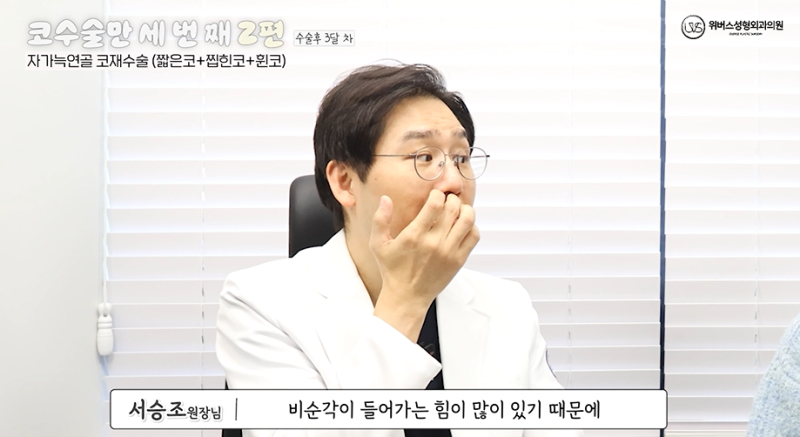
While the nose tip might feel slightly lower compared to immediately after surgery, this isn't a severe droop of the nose tip.
It's due to the strong force acting on the nasolabial angle when smiling,
and this change can be more pronounced in individuals with strong facial muscles when they smile.
The most concerning aspect during nose re-revision surgery

The most crucial aspect of the surgery was to prevent the nose from appearing upturned while also ensuring it didn't look too long by lowering it.
Focusing solely on lowering the nose could result in an unnatural appearance,
so this aspect required the utmost care during the surgery.
Fortunately, the surgery was successful, and since the patient traveled all the way from Japan,
we put a lot of effort into achieving the most satisfactory result possible with a single surgery,
and it was a relief for us at Wevers that it led to a good outcome.😊
The success of a surgery doesn't always align with the medical team's judgment and the patient's satisfaction,
so we prioritize meeting the patient's needs above all else.


We are truly glad to see the patient satisfied,
and we are very pleased that the surgery was successfully completed.
We wish the patient continuous happiness.💕
Have more questions?


Frequently Asked Questions
Do I have to replace my nasal implant every 10 years after rhinoplasty?
No, it is not mandatory to replace it every 10 years. The area where problems mainly occur in rhinoplasty is the nasal tip, not the bridge of the nose. If a comfortable structure is created for the silicone to settle stably at the nasal tip, the implant can be maintained without periodic replacement.
Why is autologous costal cartilage often used for revision rhinoplasty?
Yes, it is to create a stable support structure for the nasal tip. Using autologous costal cartilage, which is autologous tissue, to build a strong support allows the silicone to remain in place even when smiling or making expressions, and the nasal tip stays comfortable and stable.
Can the nasal tip droop or look pinched over time?
Yes, this can happen if the nasal tip support weakens. Even if there are no problems immediately after surgery, the support can weaken and droop over time, causing the nasal tip to appear pinched. To prevent this, it is important to sufficiently reinforce the support with autologous costal cartilage during revision surgery.
Can the nasal tip drop further after surgery?
Yes, you might feel that it has slightly lowered due to the strength of your facial muscles. This change is more noticeable in people with strong muscles that pull towards the nasolabial angle when they smile. However, if a strong support was built, it will not droop severely, so you don't need to worry too much.
Is it always good to lower the nasal tip a lot?
No, it should be approached differently depending on the patient's muscle type. If a person has muscles that cause the nasal tip to rise when they smile, lowering the nose excessively can make it look unnatural and long. Therefore, it is important to perform surgery at an appropriate height, considering facial expressions and muscle movements.