2026-05-29
Recommended Cases for Autologous Rib Cartilage Rhinoplasty? (Contracted Nose, Revision Rhinoplasty)
#AutologousRibCartilageRhinoplasty #AutologousRibCartilage #AutologousRib #GangnamAutologousRib #GangnamRhinoplasty #ProtrudingMouthNose #ProtrudingMouthRhinoplasty #FlatNose #LongNose #DeviatedNose #SaddleNose #Uverse #SeoSeungJo #ShimJungHwan #RevisionRhinoplasty Hello~ your beauty universe! I am Dr. Seo Seung-jo from Uverse Plastic Surgery :)💚 Because the nose is located in the center of the face, changing just its height can give the overall image a three-dimensional change, making it the mo

#AutologousRibCartilageRhinoplasty #AutologousRibCartilage #AutologousRib #GangnamAutologousRib #GangnamRhinoplasty #ProtrudingMouthNose #ProtrudingMouthRhinoplasty #FlatNose #LongNose #DeviatedNose #SaddleNose #Uverse #SeoSeungJo #ShimJungHwan #RevisionRhinoplasty
Hello~
your beauty universe! I am Dr. Seo Seung-jo, head director of Uverse Plastic Surgery :)💚
Because the nose is located in the center of the face, changing just its height
can give the overall image a three-dimensional change,
making it one of the most preferred surgical areas after the eyes.
Depending on each individual's nasal bridge height, skin, width, and alar shape,
the surgical method varies, but generally, the materials used are
silicone for the nasal bridge, and septal cartilage or ear cartilage for the nasal tip.
However, recently, there has been a high reluctance toward these artificial implants,
so more people prefer autologous cartilage, leading to an increase in autologous cartilage surgery cases.
Autologous rib cartilage is stronger than other materials, and it has the advantage
of providing a sufficient amount and length of material.
However, because it also has the disadvantage of potentially leaving a slight scar,
it is not preferred by those who feel burdened by scarring.
Then, are there recommended cases where autologous rib cartilage must be used?
"What are the recommended cases for autologous rib cartilage?

It would be most efficient to use it in cases
that can best utilize the characteristics of autologous rib cartilage (firmness and large quantity).
Therefore, it is highly recommended for very short noses, contracted noses, severely deviated noses, and saddle nose reconstruction surgeries.
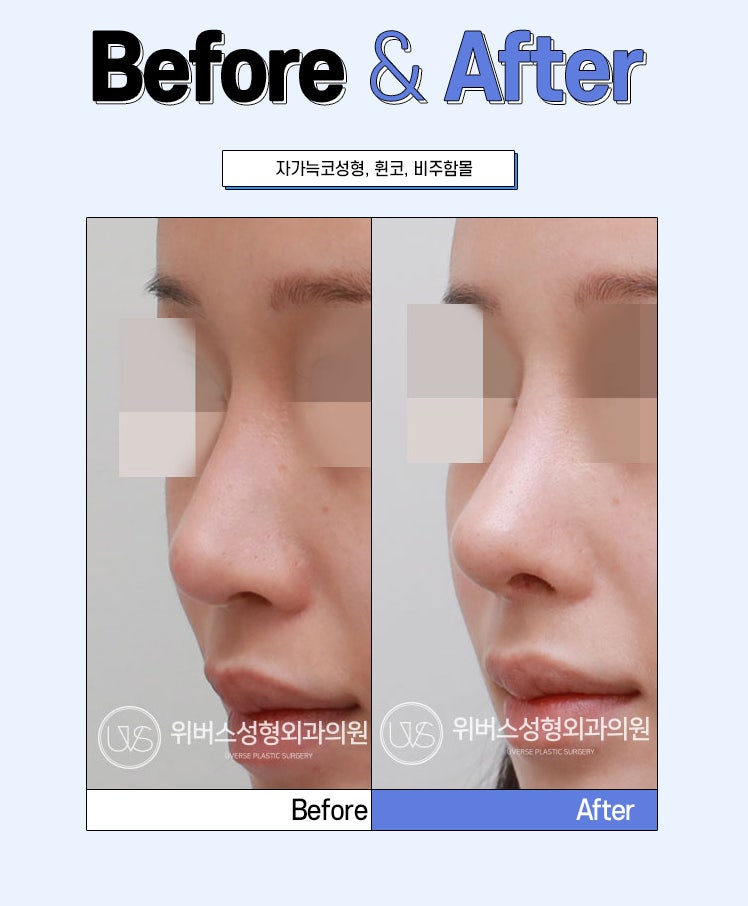
Today, we looked into the recommended cases for autologous rib cartilage.
Because autologous cartilage has its pros and cons, a pre-operative consultation with a specialist is very important.
For this reason, rather than visiting the clinic with a surgery plan using only one specific material,
we recommend choosing the right material for you through a consultation with a specialist.
❤ Want a quick consultation?



Frequently Asked Questions
What are the advantages of autologous costal cartilage rhinoplasty?
Yes, the biggest advantage of autologous costal cartilage is that it is stronger than other cartilage materials and provides a sufficient amount and length of material that can be used. It is an autologous tissue that can be safely chosen by those who have a rejection to artificial implants.
Are there any disadvantages or side effects when undergoing autologous costal cartilage surgery?
There is a disadvantage that a small scar may remain at the site where the cartilage was harvested. Therefore, for those who are greatly burdened by scars on their body, autologous costal cartilage harvesting may not be preferred, so sufficient consultation with a specialist is necessary.
In what cases is autologous costal cartilage rhinoplasty recommended?
It is recommended for special cases where the hardness and large quantity of autologous costal cartilage can be utilized. Typically, it is most efficient for difficult revision rhinoplasty such as very short noses, contracted noses, severely deviated noses, and saddle nose reconstruction.
What materials are typically used for the nasal bridge and nasal tip during rhinoplasty?
Generally, implants such as silicone are often used to heighten the nasal bridge, and autologous cartilage such as septal cartilage or ear cartilage is mainly used to correct the nasal tip. However, the surgical materials may vary depending on the individual's nasal condition and preference.