2026-05-29
[Real Patient Case] Natural Adhesion (Dermal Adhesion) + Lateral & Lower Canthoplasty
#NaturalAdhesion #PtosisCorrection #EyeSurgery #GangnamNaturalAdhesion #DermalAdhesion #LateralCanthoplasty #LowerCanthoplasty #CornerCanthoplasty #RevisionEyeSurgery #GangnamDoubleEyelid #GangnamCanthoplasty #GangnamCanthoplastySurgery #GangnamEyeSurgery #Uber #UberEyeSurgery #ShimJunghwan #SeoSeungjo #ShimJunghwan[Natural Adhesion, Corner Canthoplasty] Before surgery, 2 months post-opThe eyes, which are the first feature we encounter on a person's face, play a significant role in determining
![[Real Patient Case] Natural Adhesion (Dermal Adhesion) + Lateral & Lower Canthoplasty](/uploads/uberps1/223510080034/62544a336222e268.jpg)
#NaturalAdhesion #PtosisCorrection #EyeSurgery #GangnamNaturalAdhesion #DermalAdhesion #LateralCanthoplasty #LowerCanthoplasty #CornerCanthoplasty #RevisionEyeSurgery #GangnamDoubleEyelid #GangnamCanthoplasty #GangnamCanthoplastySurgery #GangnamEyeSurgery #Uber #UberEyeSurgery #ShimJunghwan #SeoSeungjo #ShimJunghwan
The eyes, which are the first feature we encounter on a person's face,
play a significant role in determining first impressions.
In the case of Asians, many people have eyes without double eyelids or with horizontally long, thick eyelids.
Today, we will look at a real patient case
who had surgery at our clinic for monolids, stuffy outer eye corners, and thick eyelids!
Before Surgery
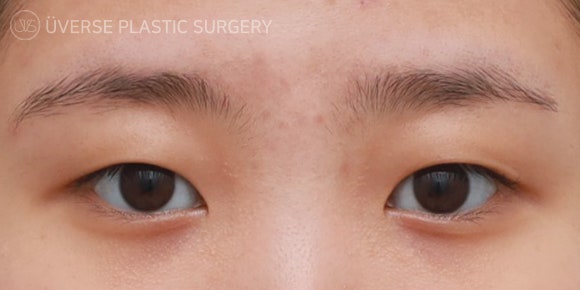
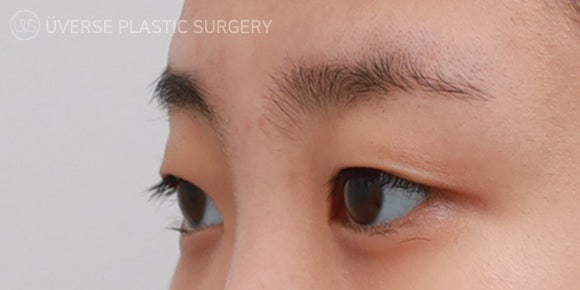
This patient had bulging monolids and, since it was her first double eyelid surgery, she wanted a non-incisional method.
Also, she was concerned about her stuffy outer eye corners and wanted to create a semi-out fold double eyelid line.
Although she had monolids and slightly bulging eyelids, her skin was not sagging despite the protrusion, and her eye-opening muscle strength was close to normal.
Her epicanthal folds were not severe, so when we simulated the line, an in-out to semi-out fold line was possible without looking unnatural.
Because her outer eye corners were slanted upwards, her eyes were not small, but they looked somewhat stuffy.
The patient also asked if it was possible to achieve a gentle, "puppy-dog" eye look with lowered outer corners.
Consultation and Surgical Process
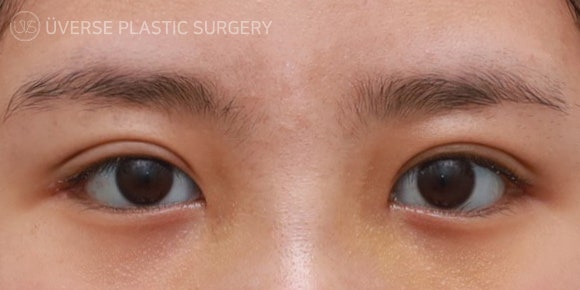
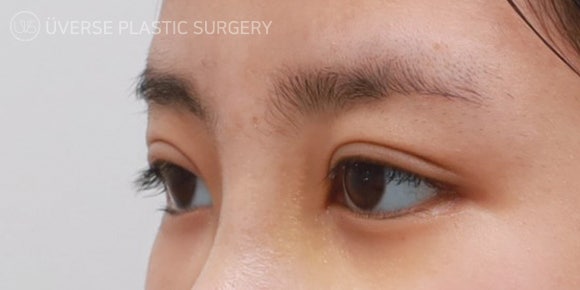
Her eye-opening strength was slightly weaker on the right side compared to the left, but since ptosis correction was not absolutely necessary, we excluded it.
Taking all the factors mentioned above into consideration, we decided to create the line using only the natural adhesion (non-incisional) method,
and we planned to perform a corner canthoplasty, which lowers the outer corners to give a horizontally elongated feel + enlarges the eyes vertically.
The surgery follows the conventional natural adhesion method, where several small punctures are made to pass the thread through and secure the line.
During this process, we pay close attention to the depth at which the thread passes through the skin tunnel to ensure maximum adhesion occurs effectively.
For the corner canthoplasty, a short incision is made at the outer corner of the eye, and a new fixation is made in a downward diagonal direction, providing the combined effects of both lower and lateral canthoplasty.
To find the optimal fixation point that provides appropriate results without being excessive, we sometimes untie
and re-fixate the area a few times.
In this patient's case, her right outer corner was slanted higher, so this had to be taken into consideration.
Afterward, the incised area is sutured. Unlike other lateral canthoplasty methods, this technique minimizes mucosal invasion, which has the advantage of reducing problems like a C-shaped deformity that can occur later due to scarring.
Post-Operative Progress
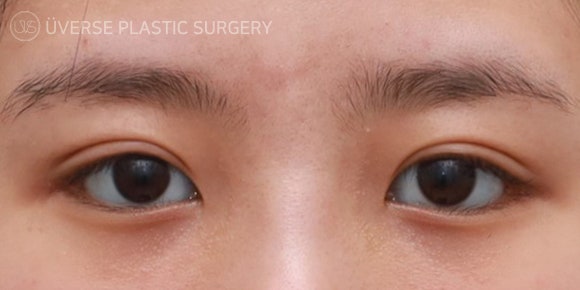
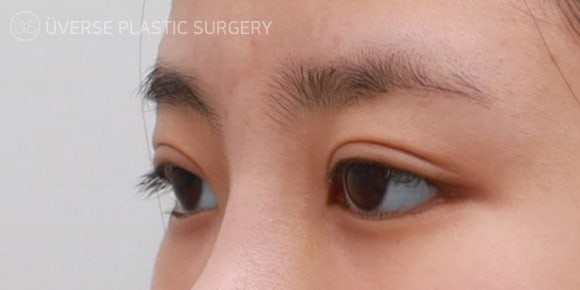
For natural adhesion double eyelids, there are no stitches to remove, and the punctured areas heal in about 3-4 days,
so you just need to wait for the swelling to gradually subside.
Usually, major swelling goes down after 1-2 weeks, and you can expect it to look completely natural after 1-2 months.
In the patient's case, the right corner canthoplasty was performed a bit more strongly, so the swelling of the double eyelid lasted longer on the right side,
but by the 2nd month, all the swelling had subsided, and you can see that the sizes matched up similarly.
With corner canthoplasty, the corners may look slightly over-lowered on the day of surgery, and opening the eyes might feel a bit uncomfortable,
but just like the swelling from double eyelid surgery, it will improve over time.
The stitches are removed after 1 week, and the scar, like any other area,
may be slightly red and bumpy for up to 1 month, but it will gradually become unnoticeable over time.
I believe corner canthoplasty has the advantage of minimal scarring and a lower recurrence rate compared to other lateral or lower canthoplasty methods.
However, it has the disadvantage of being difficult to achieve a large amount of correction. Since most patients want a moderately natural level of correction,
I think corner canthoplasty is sufficient to improve the stuffiness of the outer eye corners.
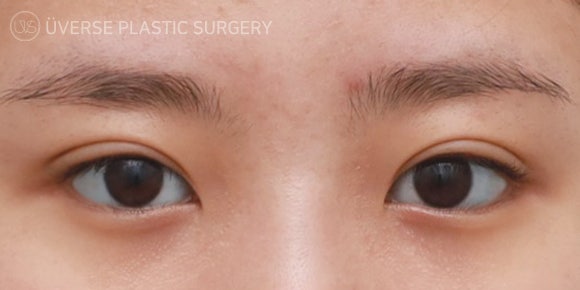
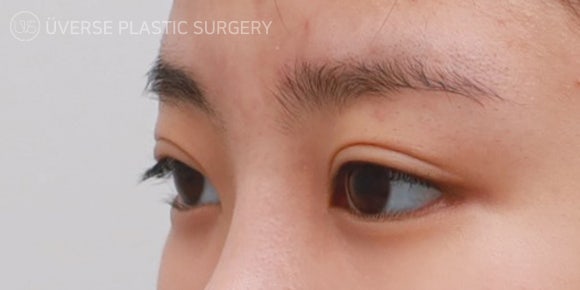
Today, we looked at a case of natural adhesion and corner canthoplasty.
We will see you next time with another case review.
If you want a quick consultation?