2026-05-29
The Meeting of Advanced Technology and Rhinoplasty: About 3D Virtual Plastic Surgery
#VirtualPlasticSurgery #3DRhinoplasty #VirtualRhinoplasty #InnofitRhinoplasty #Innofit #Rhinoplasty #GangnamRhinoplasty #UberRhinoplasty #CustomRhinoplasty #ImplantRhinoplasty #NoImplantRhinoplasty #NasalBridge #NasalTip #UberPlasticSurgery #DirectDesign “Even when looking at bamboo wares or medicinal herbs, people in the old days took ample time and poured their heart and soul into making things. In a world where people like the old man carving a wooden club are despised by young people like me
#VirtualPlasticSurgery #3DRhinoplasty #VirtualRhinoplasty #InnofitRhinoplasty #Innofit #Rhinoplasty #GangnamRhinoplasty #UberRhinoplasty #CustomRhinoplasty #ImplantRhinoplasty #NoImplantRhinoplasty
#NasalBridge #NasalTip #UberPlasticSurgery #DirectDesign
“Even when looking at bamboo wares or medicinal herbs, people in the old days took ample time and poured their heart and soul into making things.
In a world where people like the old man carving a wooden club are despised by young people like me, beautiful things cannot be created.”
From 『The Old Man Carving a Wooden Club』
The Present of Rhinoplasty
This is a sentence from an essay that is still consistently featured in middle school textbooks today.
Regarding the value of an object created with craftsmanship and utmost devotion, even if it may seem small and trivial, and the importance of its production method,
it is an essay that explains exactly that.
For those who need to use an implant during the rhinoplasty process,
the process of carving the implant to fit the individual's nose shape is inevitably involved.
This aims to make the nasal bridge line look natural, and by preventing the implant from lifting due to empty spaces between the skin, nasal bone, or cartilage,
it can prevent complications like inflammation caused by blood pooling, as well as prevent the implant from shifting or changing shape.
If a foreign substance is inserted into your body—especially in the face you see every day—and the implant does not fit your nose,
it is bound to cause psychological anxiety.
Therefore, the process of carving this implant during surgery is carried out with the utmost care, much like the feelings of the old man carving the wooden club.
We carve it using a medical scalpel, check the fit, and if it doesn't fit, we carve it again, sculpting it until it perfectly matches the desired shape.
Still, unlike the implants used in previous generations, there are ready-made products that come somewhat pre-shaped,
so the time has been significantly reduced. However, because there are individual differences in the nose shapes of patients, many plastic surgeons, including myself,
who perform rhinoplasty inevitably have to dedicate a certain amount of time to this process, whether they like it or not.
It is not just a matter of time. Sometimes, for patients with a large difference in the height of their nasal bridge, such as those with a severe dorsal hump,
there may be limits to matching the shape using only conventional implants.
In such cases, additional materials like dermal tissue or cartilage tissue may need to be used to adjust the shape.
It is truly the process of sculpting the shape of the nose.
3D Printing Technology
Until just a few years ago, 3D printing was an unfamiliar technology, understood merely as some technologically advanced new concept.
However, with the recent advancement of the technology itself, production tools like 3D printers and 3D pens
are rapidly being commercialized so that the general public can easily access them.
Cases using this can often be seen in various video media, making it an increasingly familiar technology to us.
In the medical field, this technology is contributing extensively, not only to the production of personalized medical prosthetics such as hearing aids, dentures, artificial legs, and artificial arms,
but also to the creation of virtual anatomical bodies of patients, surgical simulations, prevention of medical accidents, reduction of surgery time, increase in surgery success rates,
and even medical staff training.
There is a growing trend of such attempts being made in the field of plastic surgery as well.
Virtual Plastic Surgery
The technology that can be called 'virtual plastic surgery' is actually not a special technology.
Rather than a concept like 'Virtual Reality (VR)' or 'Augmented Reality (AR)', it operates on the principle of a plastic surgery preview,
allowing you to simulate the surgery on your own face.
In today's era where people of all ages and genders are accustomed to smartphones, you have probably taken a selfie at least once,
or experienced editing your face in a photo someone else took of you.
You might have simply used an app for automatic retouching, or somewhat more professionally,
manually adjusted and retouched the shape of your eyes, nose, or facial contours.
Although the degree may vary, we could say that we have already
tried a bit of virtual plastic surgery to create our desired facial image.
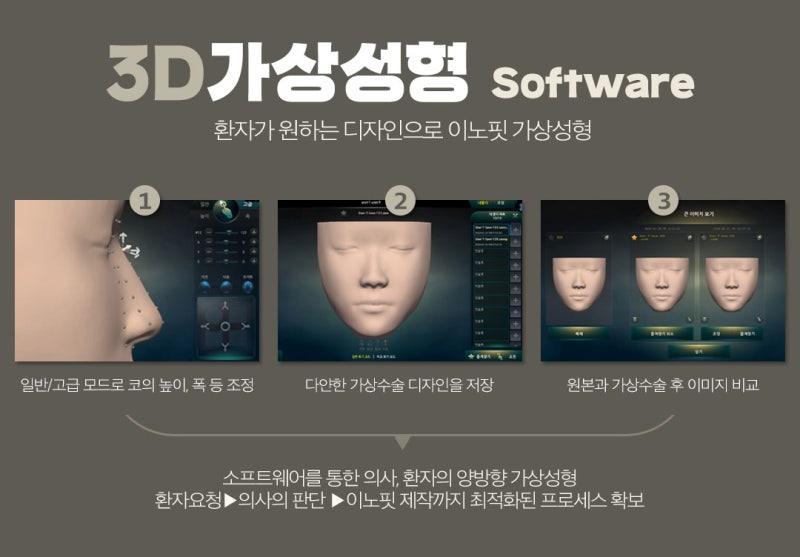
However, the differentiating factor in the field of plastic surgery is that it is not a modification of a 2D image like a photograph,
but rather the ability to 3-dimensionally edit your actual face modeled using CT scans or 3D cameras.
For example, in a photo showing your side profile, you can increase the height of the nasal tip through editing,
but you cannot modify the frontal image (the width of the nasal bridge, the width of the alar, etc.) that does not appear in that photo.
However, if you can modify your face in 3D by rotating it around, much like customizing a game character's face,
the degree of freedom in that editing increases significantly.
Therefore, correcting your elaborately 3D-modeled facial image before surgery
is one of the best ways to comprehensively check the post-operative feel that cannot be seen in 2D photos.
There have been many advancements in plastic surgery techniques.
Research on tools and materials has also progressed alongside them, greatly helping to improve the quality of surgical outcomes.
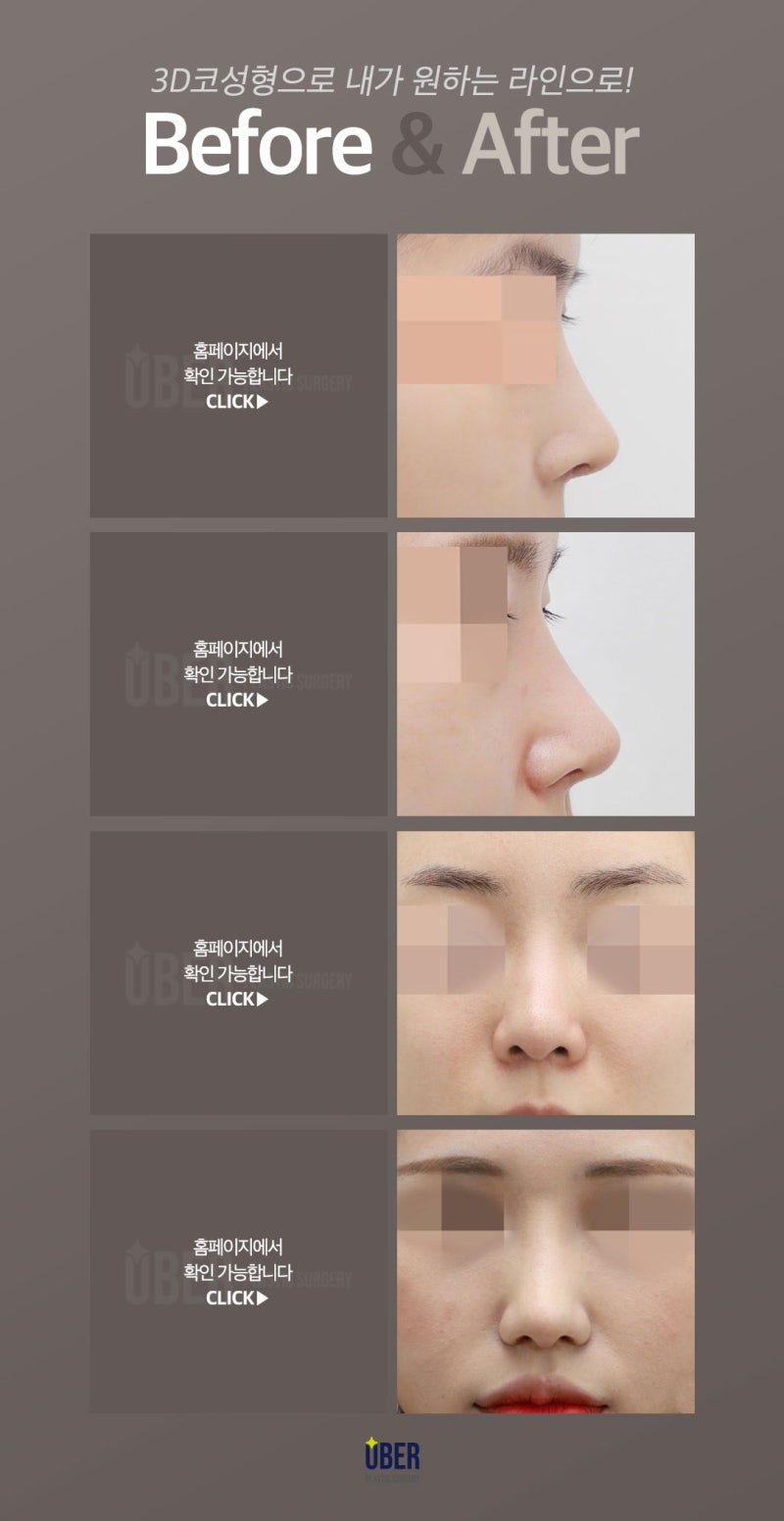
At Uber Plastic Surgery, we incorporate the aforementioned advanced technologies into rhinoplasty for consultations and surgeries.
Before surgery, you will proceed with a consultation with me while directly interacting with your 3D-modeled face, and this allows you to
somewhat predict your otherwise vague post-operative appearance. Through detailed simulations of the areas that can be improved,
it enables us to create a guideline for the best possible nose shape you can achieve.
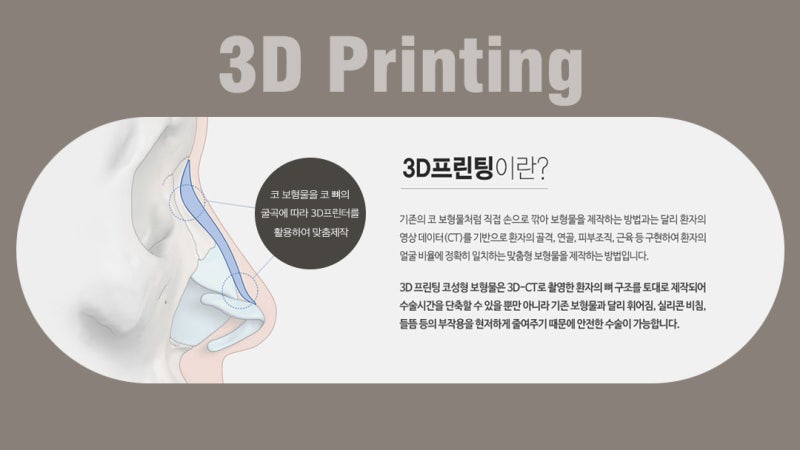
Additionally, because it is a 3D-modeled image taken after a CT scan, we can check the positional relationship of the cartilage and bone tissues under the skin,
making it possible to manufacture a custom implant exclusively for you that perfectly fits the virtually modeled nose shape.
Along with the minor advantage of reducing surgery time, this can also decrease the margin of error found in human-carved implants,
and ultimately helps in creating a natural nasal bridge line.
Therefore, 'virtual plastic surgery and custom implant production' serves as a consultation method utilizing various 3D technologies and new approaches,
which can be a very excellent alternative for those considering cosmetic rhinoplasty.